
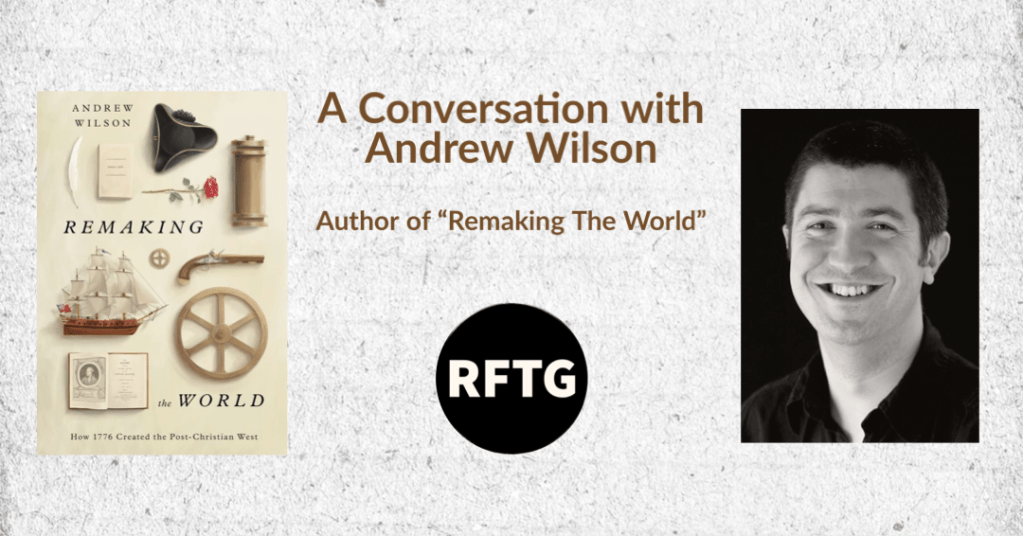
Recently, RFTG featured an article discussing Remaking The World by Andrew Wilson. We invited him to be a guest on the RFTG Podcast, however a conflict in schedule did not permit us to host him on the show. However, Andrew was extremely gracious to answer a few questions for us about his new book in a print interview. What follows are his responses to questions submitted by RFTG Editor, Zach Kendrick.
____
Andrew Wilson (PhD, King’s College London) is the teaching pastor at King’s Church London and a columnist for Christianity Today. He is the author of several books, including Incomparable; Echoes of Exodus; and God of All Things. Andrew is married to Rachel and they have three children: Zeke, Anna, and Samuel.
____
For our readers who may not be familiar with your writing, can you share about your ministry and writing?
Sure! I’m the Teaching Pastor at King’s Church London, I have a PhD in biblical studies, I’m a columnist for Christianity Today, and I sometimes speak at conferences and events. I’ve also written a number of books, most recently God of All Things and Remaking the World.
It’s been said that we need to know our past so that we can better understand our own times. Do you resonate with that? How do you think that a better understanding of history help us learn from the past, so that we can better understand our own cultural moment?
Observing the modern world without knowing our history is like walking into a conversation halfway through and trying to work out what’s going on. You may get the hang of lots of it, and be able to make some important contributions, but there are various things you won’t be able to make sense of at all, and your ability to shape the discussion will be limited as a result. In reality, I think we all operate with a functional account of our history; we are storytelling creatures and we can’t really help it. But many of our accounts are wildly inaccurate, and can lead to clunky, foolish or fearful responses to complex issues.
In your book you specifically discuss how 1776 transformed the modern world and made it WEIRDER (Western, Educated, Industrialized, Rich, Democratic, Ex-Christian and Romantic). That’s not just a catchy acronym, but the fact that the modern west are those things makes us very different from the rest of the world. How so?
Well: most people alive today do not think the same way as Western people do about the world, truth, love, family, God/gods, identity, the self, the past, the future or the best way to live. As soon as we travel, or read history, we encounter that first-hand. Part of what I’m doing in the book is to explain why that is true, and where those WEIRDER values come from.

Your book expounds upon the work of anthropologist Joseph Heinrich who coined the term WEIRD. Why did you think it was important to include Ex-Christian and Romantic to the conversation?
Henrich’s acronym deals primarily with material and political circumstances: the financial, technological, geographical and governmental context in which we live. I wanted to talk about the role of ideas as well, and I think Christianity is by far the most important long-term belief system in shaping the modern West, and Romanticism the most important more recent one. I think Henrich agrees in many ways, actually; his most recent book explains the WEIRDness of the West with reference to the influence of Christianity, specifically the Roman Catholic Church.
What are 2-3 implications of our WEIRDER world for us as Christians? How can understanding these help Christians be more effectively bear witness to the gospel?
That’s a huge question, which takes two chapters of the book to summarise! But in brief, I talk about the way that being WEIRDER shapes our societies, families, psychology, careers and art, and then suggest several ways in which Christians can engage fruitfully with contemporary culture. I focus particularly on grace, freedom and truth as areas where modern Westerners are receptive to the gospel, and talk about some of the implications for our corporate worship, engagement with public issues and apologetics.
In the next to last chapter you make mention of several hymns that came out of the 1770’s, most notably “Amazing Grace” and “Rock of Ages,” which have been sung countless times over the past couple centuries. How do these songs help Christians navigate a WEIRDER world?
Those two hymns are good examples of a wider trend in hymnwriting at the time, which was the relentless focus on the experience of grace in the life of the believer (“I was blind but now I see,” “thou must save and thou alone,” and so forth). Obviously that is something that has always been vital for Christians. But it can be particularly helpful in reaching the WEIRDER world, where identity and status are so often secured by works. I talk a lot about that in the final chapter.
How do you hope that the Lord will use the book in the lives of those who read it?
For one thing, I hope that people enjoy reading it. I think it’s a really fantastic story and I hope people find it as fascinating as I have. But I also hope it helps people understand the world around them better – how their neighbours think, why their children say the things they do, what is happening in sports and politics and music and the arts, and so forth – and how to respond lovingly and wisely.
At the end of the book you state that this was the most fun you had writing a book. How so?
The main thing was how much I enjoyed learning about all this stuff: seeing the connections between inventions, wars, books, revolutions and ideas that I had never seen, and meeting some extraordinary characters I had never heard of. Johann Georg Hamann, Olaudah Equiano and Erasmus Darwin were three people I knew virtually nothing about when I started, and I just love discovering new things.
Do you currently have any future writing/book projects in the works?
At the moment I’m just pulling some ideas together for a book on happiness. We shall see!
Editor’s Note: RFTG would like to thank the author for generously taking the time to provide thoughtful answers to the questions above.
Like the content you see on Reading For The Glory? Please subscribe by providing your email at the bottom of this page. We invite you to consider supporting the ongoing ministry of RFTG. To donate click here.
To learn more about the good news of Jesus Christ, please click here.
Discover more from Reading For The Glory
Subscribe to get the latest posts sent to your email.
